
The basic purpose of ideal institutions of learning is to nurture responsibility in children, through careful observation and alert responsiveness. This will enable them to go beyond the idea of the wants of their individual self and realize them as a part of an interconnected whole. The children will also be trained to look at the fundamental factors of any given situation through which an internal process of transformation happens.
The advent of readily and easily available flood of information has led to two major concerns amongst many others, especially in children. First, it has reduced attention spans which make sustained thought and deep inquiry difficult. Second, it leads to an imbalanced development of the physiological and psychological self. These continuous impact of excessive stimulation are leading us towards a major challenge of our times- the inability to take up a responsibility and act upon it due to lack of interest, boredom, laziness etc. The conditions are similar in the majority of children across India, probably across the globe, irrespective of their physical, geographical environments, social and traditional enculturations.
In order to nurture this in children, we will have to identify or train teachers who are not mere information gatherers or transmitters but are agents of transformation through various creative pursuits. This is not anything new but already being experimented and practiced through the cycle of ‘reflection-action’ by various small groups, across the globe. These diverse open-ended communities of learning practices have arrived at contextual solutions in their own possible ways and means, as an attempt ‘Towards Naitalim.’
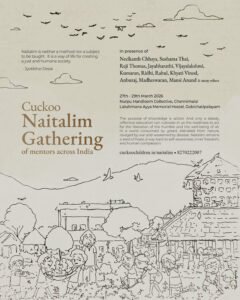
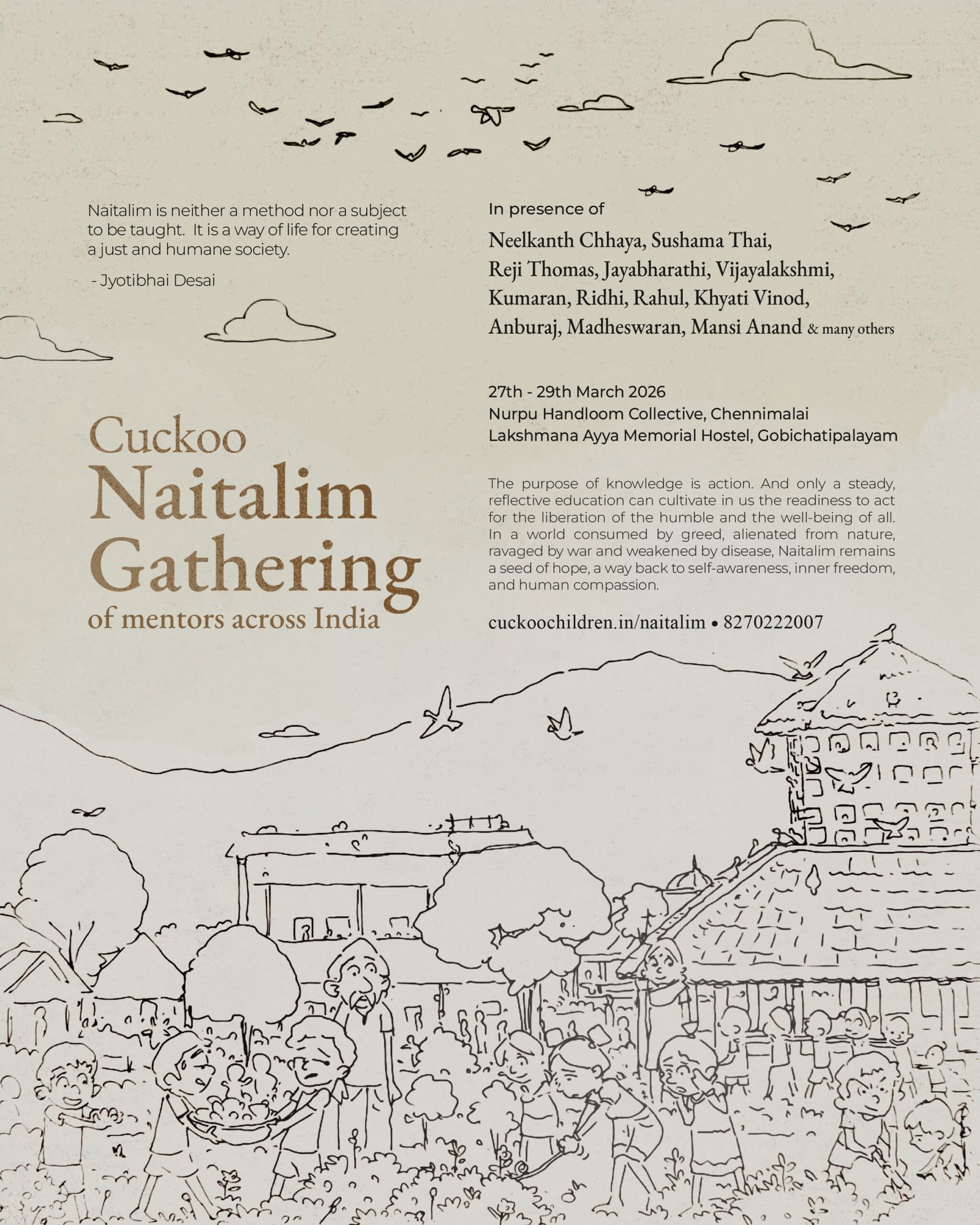
In this regard, we consider it necessary to hold a collective gathering to bring together various people who work in the area of education to discuss, formulate and share the ideas and develop pedagogy for implementing to suit the present times.
This proposed three day gathering will be an exploration of such isolated practices coming together, for filling in each other’s gap through sharing of their expertise, experiences, resources etc. Here both experienced and new ones come together so the nature of the baton passed on remains as is. Together through dialogue. There might be a ‘Naitalim Collective’ formed or eventually something hopeful will definitely happen leading to a society where there is hope and compassion. This is proposed as a jointly held gathering by various organisations and learning spaces, under the auspices of various mentors across India at the Cuckoo Forest School in Tamilnadu.
This gathering is proposed to be held on 27, 28 and 29 March 2026.
To be a part of this gathering, kindly register here.
In Presence of
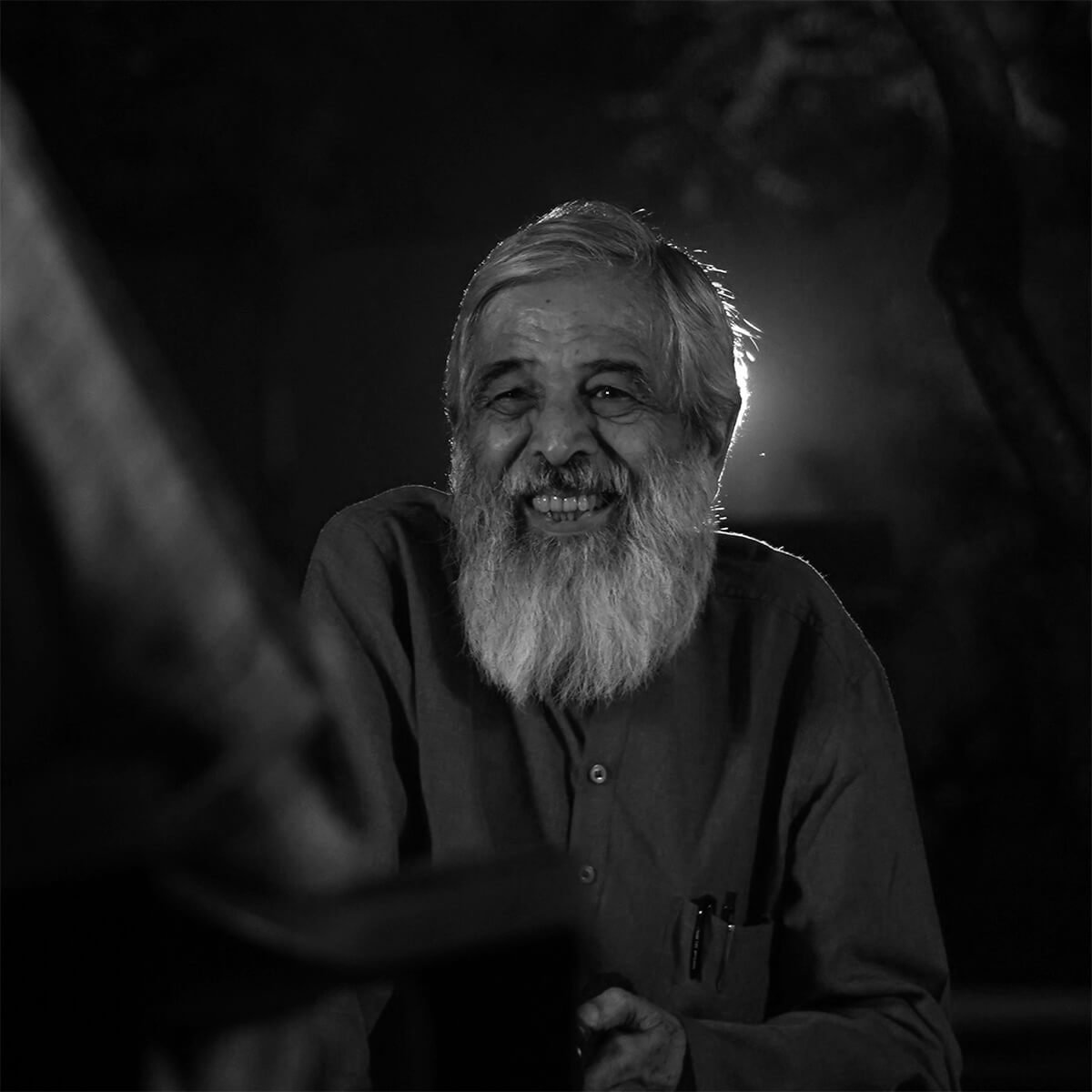
Neelkanth Chhaya
He was faculty at School of Architecture at CEPT and other design schools and he retired as the Dean in 2013 and continues to guide the students till today, both in academic and non academics. He has been an Adjunct Faculty at Srishti Institute of Art, Design and Technology, Bangalore, since 2015, and holds the UNESCO Chair in Heritage, Sustainability and Livelihoods at Srishti. He has served on Academic Councils and Boards of Studies at several institutions.
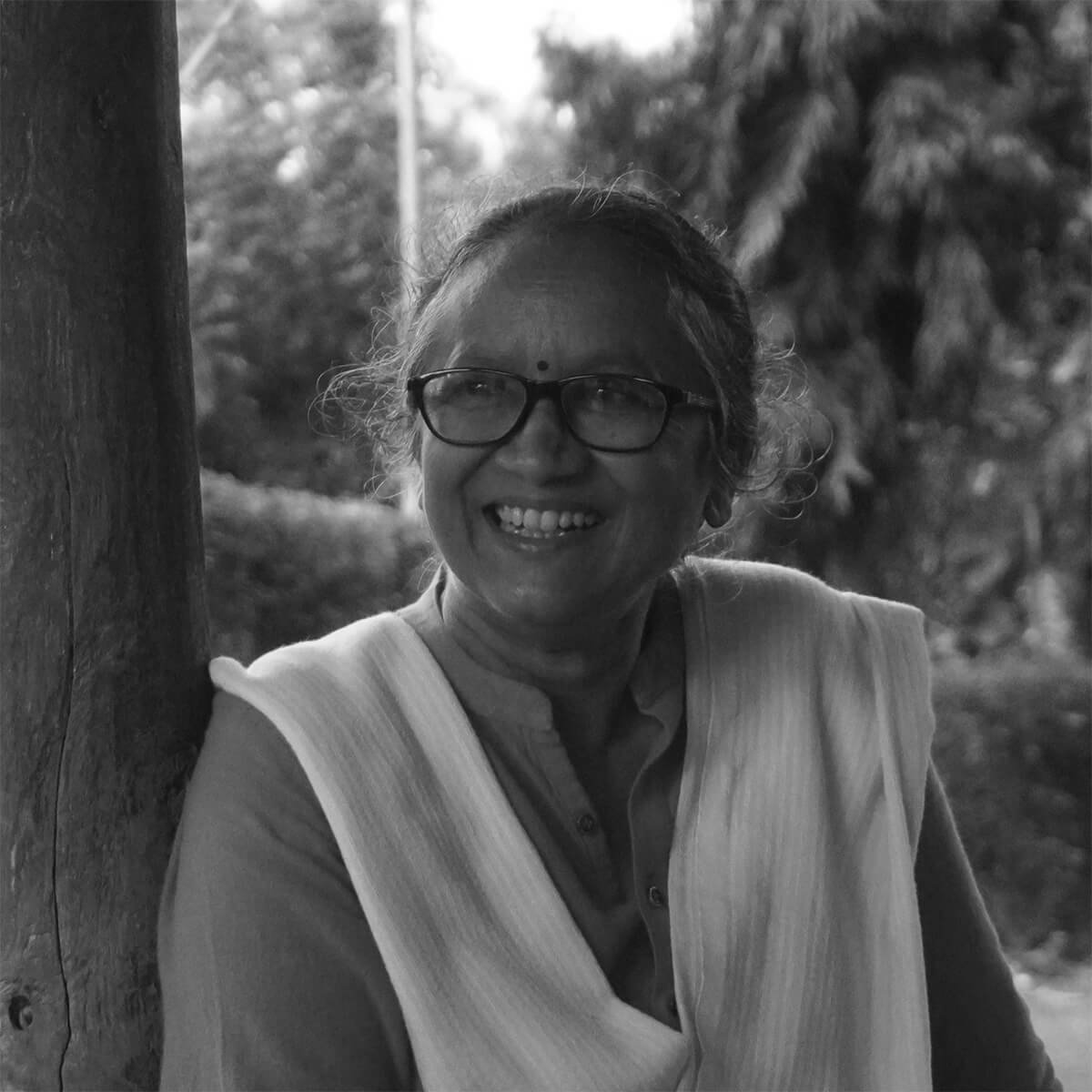
Sushama Thai
Sushma Sharma is a social activist and teacher who is confident about this because she has worked with the Naitalim philosophy developed by Mahatma Gandhi. She is currently principal of the school being run by the Naitalim Samiti at Sevagram Ashram (Wardha), which was Gandhi’s last home.
Reji Thomas
Interdisciplinary scholar and consultant with three decades of experience in sustainable development, decentralized planning, rural industrialization, and environmental assessment. Trained at IIT Bombay and Gandhigram Rural University, with extensive academic, research, and entrepreneurial contributions.
Jayabharathi
Jayabharathi amma has been managing Siddhartha Matriculation Higher Secondary School since 1987. In her 37 years of educational activities, she has introduced many innovative ideas and created an alternative educational environment. She is emphasizing an education system that emphasizes human values along with grades-based education. She is introducing many events to the students to enhance the multifaceted views of the children.
Vijayalakshmi
Viji, an art teacher believes that Krishnamurti’s teachings act as a mirror in which one can comprehend ourselves and the complex movement of fears, sorrows, desires and loneliness, which are indeed common to all mankind. These teachings are not a guide, a set of ideals or a framework; to any particular way of living; they do not offer a technique or method to free oneself of psychological misery. They are not an abstract philosophical system. She is also part of Shibumi which is not a community that one joins. It is a coming together of individuals, in the spirit of freedom and cooperation, in the movement of self knowing through dialogue and observation.
Kumaran
Kumaran, a prominent teacher at Shibumi, which is a learning centre for adults and young people. It offers a space where, through dialogue, one understands oneself and relationships in the light of Krishnamurti’s teachings. Shibumi offers a learning environment where they can grow and flower in goodness. Kumaran teaches Mathematics for senior school.
Ridhi Aggarwal
Ridhi has 4 years of corporate and 2 years of teaching experience before Swatantra Talim. Her focus points are strategy, curriculum, and training. Before Swatantra Talim, she worked in corporates, NGOs, and schools like Times of India, Edelweiss Capital, Nalanda (Lucknow), and Sahyadri School (Krishnamurthi Foundation India). She is also an avid storyteller and an origami lover. Ridhi has been instrumental in co-creating maker-spaces in public, private schools and non-formal learning centers.
Rahul Agarwal
Rahul, a qualified CA, is the other co-founder of Swatantra Talim. Actively engaged in monitoring and evaluation of our program by looking closely the gaps in terms of delivery, he has been instrumental in devising the organisation’s strategy, curriculum, implementation and performance monitoring. Currently pursuing a Masters in Design Education from Srishti Manipal Institute of Art, Design and Technology, Bangalore, he also holds an MA in Elementary Education from TISS, Mumbai. Prior to Swatantra Talim, he did a stint in Sahyadri School, Pune (KFI India) as a bursar-cum-teacher.

Khyathi Vinod
Khyati is a creative practitioner working at the intersection of craft, pedagogy, and community knowledge systems. Over the past seven years with Khamir through the Sugri Shala initiative, she has developed craft-integrated approaches grounded in local contexts. She is also a core member of Living Lightly ~ Journeys with Pastoralists, a travelling exhibition that traces the life worlds of nomadic pastoralist communities in India.

Anburaj
Anburaj is known as an honest man who traveled a path of deviation in his youth, then recovered from it, returned without any hesitation, and set his life in the right direction. His life, in which he was convicted of serious crimes, sentenced to prison by the law, released from prison, and engaged in social activities, inspires hope in every person who knows him. He has been involved in the forest-based lifestyle since childhood.
Mansi Anand
Mansi Anand is the Education Lead at Khamir, where she works at the intersection of craft, pedagogy, and community knowledge systems. She worked with Kutch Nav Nirman Abhiyan, a network of grassroots organizations, during which Khamir was initiated in the aftermath of the Gujarat earthquake, marking her early connection to the organization. She also has experience as a journalist covering human interest and research-based stories.
Madheswaran
The founder of the Kalaithai Foundation—a veteran master who is someone unaware of reading and writing. For over forty years he has dedicated himself to reviving Tamil traditional arts, training the younger generation, molding them into teachers, and guiding them to travel across various parts of Tamil Nadu to carry out this work.